
Lesson MINI

Britannica School logo in navy blue and green text

LESSON MINI

Celebrating Black Voices

Grade:

3-5

Topic:

Black History Month

Unit:

Black History
Eye icon in white on red background

Overview

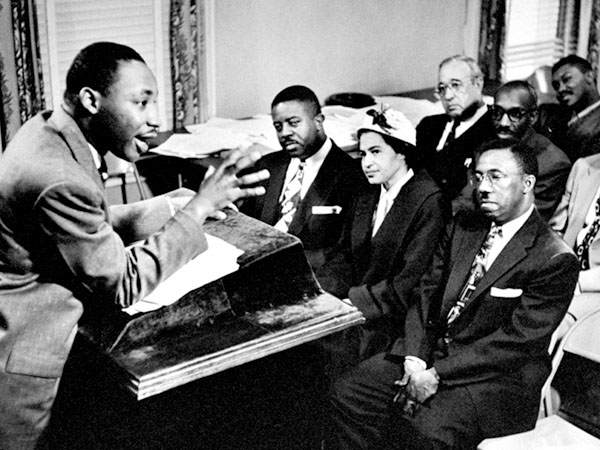
Civil rights leaders meeting led by Dr. Martin Luther King, Dr. in formal setting, 1960s era.
© Don Cravens—The Chronicle Collection/Getty Images

In this lesson mini, students explore how Black Americans have shaped the United States through courage, creativity, and community leadership. They learn about diverse contributions, from the struggle for freedom to artistic and scientific achievements, and consider how these stories connect to values of fairness, identity, and pride.

Ideas for Implementation
Social Studies
Literacy
Library media
Learning centers
Intervention or enrichment
Key Vocabulary & Definitions
bravery (noun): a quality that allows someone to do things that are dangerous or frightening
civil rights (noun): guarantees of equal social opportunities and equal protection under the law, regardless of race, religion, or other personal characteristics​
conductor (noun): a person who ensures people’s safety and collects money or tickets from passengers on a train or bus​
courage (noun): a quality that enables someone to do things that are difficult or dangerous​
enslaved (adjective): describing people who have no freedom or who are forced to work for no pay and who can be sold or separated from family​
equity (noun): the ideal of fairness and uniformity in treatment or status by those in power
hero (noun): a person or fictional character who shows great courage
integration (noun): a policy that ends segregation
justice (noun): the practice of being fair to everyone, treating people equally, and making sure things are balanced and right​
postpone (verb): to put off to a later time
resilient (adjective): able to withstand or recover from difficulties
segregation (noun): the practice or policy of keeping people of different races, religions, etc., separate from each other
Authentic Learning Extensions
Authentic learning opportunities for studying Black voices that demonstrate courage, creativity, and community involve real-world experiences and practical applications that help students understand social justice concepts meaningfully. Here are some examples:
Documentary Discovery: Encourage students to explore age-appropriate documentaries or short video segments that highlight the achievements of Black leaders, artists, scientists, musicians, and community builders. Invite students to record questions that arise and compare the different types of contributions they observe.
Local Landmarks Exploration: Research local places that honor Black history such as murals, parks, statues, plaques, street names, community centers, or historically significant neighborhoods. Students investigate who is honored, why they were chosen, and how communities remember important contributions.
Music Exploration: Invite students to listen to a selection of music created by Black musicians across different styles such as jazz, blues, gospel, or contemporary genres. Ask them to describe what they hear, how the music makes them feel, and what questions the music inspires about the artists who created it.
Oral History Appreciation: Invite students to listen to short age-appropriate oral histories from Black artists, scientists, or innovators available through public archives. Students jot down questions that arise, reflect on memorable moments, and compare how stories are told in spoken versus written forms.

Choose Activity

5
Celebrating Black Voices

Activity

1 :

Harriet Tubman: Courage in the Underground Railroad

By the end of the activity, students will be able to describe how Harriet Tubman’s courageous acts helped others gain freedom.

>40

Minutes

Materials

Digital devices such as Chromebooks or tablets (one per student)
Whiteboard and display
Writing utensils

Resources

1
Tell students that during today’s activity they will learn about how Harriet Tubman courageously helped guide enslaved people to freedom.
2
Begin the lesson by defining the word courage on the board as “a quality that enables someone to do things that are difficult or dangerous.” Explain that the word bravery has a similar meaning. Then ask:
What does courage mean to you?
When have you acted courageously?
Who is a brave person you know?
What are examples of everyday courageous acts?
3
Share with students that they will watch a brief video about a very brave woman named Harriet Tubman. Display the Harriet Tubman video, and afterward invite students to share what they learned. Record their ideas on the board. Encourage students to notice information that helps them understand who Harriet Tubman was and what actions she took. Consider asking the following questions:
Who was Harriet Tubman?
When and where was she born?
What role did she play in the American Civil War?
What did she dedicate her life to after the war?
4
Distribute a printed copy of the Harriet Tubman article to each student. Preview that this article tells the story of how Harriet Tubman became a railway “conductor” to help enslaved people find their way to freedom. Then divide the class into pairs, display the Mini Biography graphic organizer, and distribute a copy to each student. Explain that biographies tell the stories of real people’s lives, and review the parts of the organizer with students. Ask pairs to read the article, and then complete the organizer together.
5
As students finish, bring the class back together and invite students to share their findings. Facilitate a discussion focused on different ways Harriet Tubman showed courage. Ask:
What is Harriet Tubman known for?
What are important facts about her life?
What can we learn from her bravery?
6
Explain to students that they will draw inspiration from Harriet Tubman’s life to work on “Courage Portraits” to show historical and modern heroes. Tell students that the goal is to recognize individuals who have shown courage in ways that had a positive effect on others.
7
Draw a bubble web on the board, and write “brave heroes” in the center. Then invite students to share examples of Black historical figures and modern-day individuals who have stood up for what is right (for example, Harriet Tubman, Rosa Parks, Martin Luther King, Jr., John Lewis). Encourage students to think broadly about people from different communities and time periods whose actions helped others.
8
Divide the class into groups of four to six students, and give each student a digital device. Have students create a collaborative digital “Courage Portrait” collage with images of brave individuals. Display the Model “Courage Portrait” Collage to set expectations. Then invite students to work in their small groups.
9
As students finish, invite each group to present their work. For larger class sizes, consider printing out or displaying each poster and having students participate in a gallery walk.
10
Wrap up the activity by having students sit in a circle for a whole-group discussion and community-building activity. Ask, “What does it mean to stand up for what is right?” and “How did Harriet Tubman use her bravery to stand up for others?” Invite students to reflect on how learning about different courageous figures can help us understand the many voices and contributions that shape our communities.
Language Support: Pre-teach key vocabulary supported by visual aids to help students better understand the lesson. Offer students the option of reading the Harriet Tubman article both in English and in their home languages. Also, group students strategically so that they are paired with others who share their same language while they work on the “Courage Portrait” collage.
Courageous Heroes: To support students in making their collages, provide them with a list of Black historical figures and modern-day trailblazers who have acted courageously. This supports students as they select individuals for their collages while keeping them focused on celebrating Black voices during Black History Month.
Biography Spotlight: Invite students to choose one influential Black figure from their collages and write a brief biography outlining the figure’s legacy and what the person is most known for. This variation deepens inquiry as students explore how courageous actions can influence communities.
“Courage Portrait” Collage: Have students create analog collages instead of digital ones. Distribute poster boards, glue sticks, scissors, and coloring supplies to each group. Give students the option of using digital devices to search for relevant images to print out and glue onto their collages.
Parallel Teaching: For collaborative teaching and learning environments, this learning activity is well suited to a Parallel Teaching strategy. In this model, the class is divided into two groups, and each teacher delivers the same activity simultaneously to their group. This reduces the student-teacher ratio, allowing for more interaction and individualized attention. With smaller groups, students are more likely to participate actively and receive immediate feedback, which fosters a deeper understanding of the content and promotes a more engaging learning experience. Evidence suggests that small-group instruction leads to increased student engagement and improved academic outcomes.
Celebrating Black Voices

Activity

2:

George Washington Carver: An Influential Scientist

By the end of the activity, students will be able to describe the important contributions George Washington Carver made to help farmers grow their crops more efficiently and sustainably.

>40

Minutes

1
Tell students that today they will investigate how George Washington Carver used scientific thinking to support farmers and communities in the South in the early 20th century. Explain that Carver is one of many Black scientists whose ideas influenced agriculture, and invite students to explore Carver’s contributions with an inquiry mindset.
2
Begin the lesson by sharing that Carver was an agricultural scientist who studied how to make food and plants grow better. Ask students:
How do farmers help us get our food?
What famous scientists do you know about, and what were their contributions?
3
Display the George Washington Carver video, and give each student a Bubble Web graphic organizer. Instruct students to write “Carver” in the center of the graphic organizer and to take notes on the ideas presented as they watch the video. Afterward, ask students to share what they wrote. Ask:
What was the most important crop in the South in the 1800s?
What problem did Carver solve to help farmers?
How do peanuts help improve soil quality?
What types of products can be made from peanuts?
4
Give each student a copy of the George Washington Carver article and a George Washington Carver Questions handout. Invite them to read the article and answer the questions independently. Remind students that they are collecting evidence to understand how Carver approached real-world problems through observation and experimentation. Bring the class back together to review the answers.
5
Give each student a digital device, and divide the class into five groups. Assign each group a different topic focused on Carver’s life, such as his early childhood, his education background, his inventions using peanuts and sweet potatoes, how he helped farmers, and his honors and legacy.
6
Guide students to complete the group work:
a)
Instruct students to refer to the George Washington Carver video and the George Washington Carver article and to note important information from the two sources by writing on their copy of the article.
b)
Tell them to research additional reliable sources from a school-approved search engine, and model how to research effectively by typing relevant keywords based on different focus topics.
c)
Have students create collaborative posters to present their findings using a digital design tool of choice. Encourage students to use visual aids and be creative.
d)
As students work in their small groups, circulate and offer support as needed.
7
If time permits, bring the class back together and invite each group to briefly present their posters. As students listen to each others’ presentations, encourage them to ask questions and provide positive feedback.
8
Give a Summary Challenge exit ticket to each student. Tell them to review the George Washington Carver article, brainstorm some words that come to mind, and then write a 6- to 10-word summary about the article.
9
Tell students to exchange their article summaries with a classmate sitting nearby and compare and contrast their work.
10
Wrap up the lesson by asking volunteers to share something they learned about George Washington Carver and how scientific inquiry guided his contributions to farming communities.
Language Support: For students who benefit from additional language support, provide the George Washington Carver article both in English and in their home languages. Group students with supportive peers for the small-group task.
Summary Challenge Exit Ticket: Complete the exit ticket as a class to offer more scaffolded and guided support for the review portion of the task. This approach helps students consolidate new learning.
Plant Together: Challenge students to plant peanuts and sweet potatoes and record their growing process. This approach encourages students to make connections between Carver’s scientific investigations and hands-on observations.
Presentation Day: Break up the activity into two different days: one dedicated to the article reading and questions as well as poster creation, and the other dedicated to presentations. This gives students additional time to prepare their ideas before sharing with peers.
Team Teaching: For collaborative teaching and learning environments, this learning activity is well suited to a Team Teaching strategy. In this model, sometimes referred to as “tag team teaching,” both teachers deliver instruction together, often alternating or integrating their teaching styles seamlessly. This collaborative approach provides students with multiple perspectives and teaching styles, enriching their learning experience. By modeling effective teamwork and communication, this approach demonstrates how different viewpoints can enhance understanding and create a dynamic and interactive classroom environment. Evidence indicates that team teaching can enhance student engagement and provide a richer, more diverse educational experience.
Activity Introduction: Teacher A introduces George Washington Carver’s accomplishments and facilitates a discussion about his contributions. Teacher B displays the George Washington Carver video and distributes the Bubble Web graphic organizer, instructing students to take notes on the key ideas presented.
Independent Reading and Questions: Teacher A instructs students to read the George Washington Carver article and complete the handout. Teacher B distributes the necessary materials. As students work independently, both teachers circulate the room and offer feedback and support.
Collaborative Posters: Teacher A distributes digital devices to students and divides the class into groups. Teacher B assigns each group a different focus topic centered on Carver’s life. Both teachers circulate the room and offer support to different groups.
Exit Ticket: Teacher A distributes the Summary Challenge exit ticket and invites students to write an article summary. Teacher B circulates the room and offers support.
Activity Wrap-Up: Both teachers gather the class and facilitate a whole-group discussion to reflect on what students learned about George Washington Carver’s contributions and his impact on farmers. Teachers may support students by prompting them to connect their observations to evidence gathered during the lesson.
Celebrating Black Voices

Activity

3:

Langston Hughes: The Poet of the Harlem Renaissance

By the end of the activity, students will be able to describe the Harlem Renaissance and how Hughes used his voice to tell stories about the Black experience.

>40

Minutes

1
Tell students that during today’s activity they will learn about the Harlem Renaissance, a period of creativity that took place in the 1920s in a Black neighborhood of New York City called Harlem. They will also learn about an important writer of those times named Langston Hughes. Explain that students will explore questions, examine images, and use text evidence to build their own understanding about this period.
2
Begin the lesson by displaying and reading aloud the Harlem Renaissance article to the class. Before reading, highlight that during this time period many writers got together to write about their African American heritage. Invite students to listen for reasons this period encouraged people to express their culture through writing, art, and music. Afterward, ask:
What was the Harlem Renaissance, and why was it important?
Who were some famous writers, and what did they write about?
What genre of music was flourishing in the 1920s, and how did it influence African Americans?
Why did this period end?
3
Display the Langston Hughes image. Ask students, “What do you know about Langston Hughes?” Share that he was an important figure of the Harlem Renaissance who was famous for his poetry about the Black experience in the early 20th century. Encourage students to share observations and questions about the image before providing background information.
4
Give each student a copy of the Langston Hughes article and a Mini Biography graphic organizer. Invite students to work with a partner to read the article, highlight main ideas, and write about Langston Hughes’s life. Briefly model how to identify important facts in the article without giving interpretations of Hughes’s work. Preview both the article and the graphic organizer to clear up any questions before students begin working.
5
As students finish the task, bring the class back together and review their findings.
6
Show an image of Langston Hughes’s Montage of a Dream Deferred, and emphasize that this was his most famous work. Explain that this collection includes poems that raise questions about dreams and hopes. Read aloud the first line, “What happens to a dream deferred?” Explain that the word deferred is defined as “something that is postponed to a later time.” Facilitate a discussion based on this opening line, and ask:
Have you ever had to postpone something you really wanted? How did you feel?
What do you think was Langston Hughes’s dream?
7
Give each student one A Dream Deferred handout. For Part 1, ask them to draw and write about a dream they have. For Part 2, ask them to draw and write about a dream they think Langston Hughes had. For Part 3, ask them to answer the reflection questions. Before students begin, define the following vocabulary words on the board:
postpone (verb): to put off to a later time
resilient (adjective): able to withstand or recover from difficulties
8
As students finish, invite them to share their work with a partner. Then bring the class back together, and call on volunteers to share their ideas.
9
Facilitate a class discussion about how art and music tell important stories about how people live. Display images, from Britannica Library, ImageQuest, or another royalty-free resource, of Harlem Renaissance art, and invite students to share what they notice about the images and what questions they have. Ask:
What types of stories did the Harlem Renaissance writers and visual artists tell?
What types of stories do you think writers and visual artists tell today?
10
Wrap up the lesson by playing jazz music for the class and asking students to write about how it makes them feel. Encourage them to describe the sounds and any questions the music brings to mind.
Language Support: For students who benefit from additional language support, pre-teach key vocabulary about the Harlem Renaissance, and use visual aids to enhance understanding. Pair multilingual students with supportive peers who speak their home languages. Provide a translated version of the Harlem Renaissance and Langston Hughes articles along with the English versions to enhance understanding of main ideas. Provide sentence frames to support students in answering the written reflection questions on the handout as well as class discussion questions. Offer opportunities for students to verbally rehearse ideas before writing.
Guiding Questions: For a more focused and supported reading task, provide guiding questions instead of the Mini Biography graphic organizer to support the article reading. This approach helps students identify key ideas to better understand the text. This option allows students to work at a more supported pace.
Poetry Writing: Challenge students to write a poem based on the theme of dreams deferred. This approach encourages students to draw connections between the text and the writing extension task to create unique pieces of writing and build independent writing skills. Students may choose any poetic structure they prefer.
“I Am” Poems: Instead of focusing on Montage of a Dream Deferred, have students read the Langston Hughes poem “I, Too” and then write their own “I Am” poems. This approach encourages students to explore different literary works. Students may share their poems in small groups to build confidence with expressive language.
Parallel Teaching: For collaborative teaching and learning environments, this learning activity is well suited to a Parallel Teaching strategy. In this model, the class is divided into two groups, and each teacher delivers the same activity simultaneously to their group. This reduces the student-teacher ratio, allowing for more interaction and individualized attention. With smaller groups, students are more likely to participate actively and receive immediate feedback, which fosters a deeper understanding of the content and promotes a more engaging learning experience. Evidence suggests that small-group instruction leads to increased student engagement and improved academic outcomes.
Celebrating Black Voices

Activity

4:

Ruby Bridges: A Builder and a Dreamer

By the end of the activity, students will be able to describe Ruby Bridges’s courageous experiences as one of the first Black children to attend an all-white school in Louisiana and identify ways people can learn from the experiences of others.

>40

Minutes

Materials

Blank paper (one sheet per student)
Coloring supplies
Image of Norman Rockwell’s The Problem We All Live With (1963)
Images of Black vs. white schools in the United States from the 1950s and 1960s
Whiteboard and display
Writing utensils

Resources

1
Tell students that during today’s activity they will learn about Ruby Bridges, a young student whose experience became an important moment in United States history during the era of school integration.
2
Begin the lesson by explaining that a long time ago schools in the United States were segregated, meaning there were separate schools for Black and white children. Invite students to consider that separate schools often have unequal resources, and ask what questions this raises about fairness and opportunity.
3
Display images of Black versus white schools in the 1950s and 1960s from Britannica Library, ImageQuest, or another royalty-free resource. Invite students to describe and reflect on the differences they observe. Ask:
What differences do you observe?
Why do you think schools were separated?
Why was this unfair?
4
Display the Ruby Bridges video, and give each student a copy of the Ruby Bridges Questions handout. Explain that in the video they will see Ruby Bridges and then-President Barack Obama standing in front of Norman Rockwell’s painting The Problem We All Live With, discussing Ruby Bridges’s life experience. Rockwell was a famous American painter and illustrator. Ask students to take notes in Part 1 of the handout. Afterward, ask:
What did Barack Obama say to Ruby Bridges?
What does the Norman Rockwell painting show?
What lesson did Ruby Bridges learn in first grade?
How can you apply this lesson to your own life?
5
Display the Ruby Bridges article, and give each student a copy. Invite students to read the article with a partner and then collaboratively answer the handout questions in Part 2. Encourage students to identify key details about Ruby’s childhood, school integration experience, and later life and discuss any new ideas or questions that emerge. As students finish, bring the class back together and review students’ responses.
6
Display an image of Norman Rockwell’s The Problem We All Live With. Ask students to describe what they notice and reflect on what the artist may be showing about Ruby’s experience. Ask:
How did you feel during your first day of first grade?
How do you think Ruby Bridges felt?
What challenges did she have to overcome?
7
Invite students to imagine they are rewriting history. Emphasize that when Ruby Bridges started school, she faced a lot of racism and injustice. Ask students to think about how messages of kindness or encouragement might support someone facing a difficult moment. Give each student a blank sheet of paper as well as coloring supplies. Invite students to draw something to inspire Ruby on that day and to write words of encouragement, such as “Good luck on your first day of school!” “Have fun today!” and “I hope you learn a lot and make new friends at school!” Demonstrate the activity by drawing and writing on the board.
8
When students have completed their work, divide the class into groups of four to six students, and ask them to present their drawings or messages within their groups. Consider creating a Ruby Bridges art mural or bulletin board to display students’ work.
9
Ask students to sit in a circle and share something new they learned about Ruby Bridges. Then play a “Kind Message for Ruby Bridges” telephone game. Ask one student to think of a message and whisper it to the person sitting next to them. Instruct students to continue whispering the message until every student has heard it once. The last one says the message aloud.
10
Wrap up the lesson by asking students, “How can people show kindness and support to others in their school community?”
Language Support: For students who benefit from additional language support, pre-teach related article vocabulary such as segregation, integration, justice, equal rights, and civil rights supported by visual aids. Provide simplified versions of the article if needed, and offer sentence starters for the encouragement activity.
Adapted Article Handout: For students who need additional support, consider adapting the article handout to include more guiding questions, word banks, and sentence frames to enhance reading comprehension. This approach helps students complete the partner task.
Painters and Illustrators: Challenge students to research painters and illustrators, like Norman Rockwell, who portrayed the Black experience during the school integration period of the 1960s. Invite students to choose an art piece and craft a written reflection. Encourage students to focus on what they notice in the artwork and what questions the artwork raises about history.
Letter Writing: Invite students to write a letter to Ruby Bridges instead of drawing her a sketch. Suggest that students imagine Ruby Bridges’s age and time of life when writing the letter (e.g., her first day of school, the day she published her 1999 memoir Through My Eyes, the day she met with Barack Obama in 2011).
One Teaching, One Assisting: For collaborative teaching and learning environments, this learning activity is well suited to a One Teaching, One Assisting strategy. In this model, one teacher leads the activity while the other circulates, assisting individual students as needed. This ensures that when students encounter difficulties, they receive immediate help in the form of personalized support and answers to their questions. By addressing students’ unique needs and keeping them on track, this approach enhances individual learning experiences and fosters a supportive classroom environment. Studies indicate that immediate feedback and individualized attention can significantly enhance student understanding and retention of material.
Activity Introduction: The lead teacher begins by introducing Ruby Bridges’s life and displaying the video. The assisting teacher distributes the Ruby Bridges Questions handout and supports students with their video notes in Part 1 of the handout and afterward when they share their ideas.
Partner Reading Task: The assisting teacher distributes the Ruby Bridges article. The lead teacher displays the article and Part 2 of the handout, explains the task, and then divides the class into pairs. Both teachers circulate the room as the pairs complete the assigned reading and questions.
Kind Sketch: The lead teacher instructs students to imagine Ruby Bridges on her first day of school and rewrite history with a drawing and by writing kind words of encouragement. Both teachers circulate the room and offer feedback and individualized attention to students.
Activity Wrap-Up: The lead teacher closes the activity by asking students to share what they learned about Ruby Bridges and asking students to play the telephone game with a kind message for Ruby Bridges. The assisting teacher offers support as needed and closes by asking students how they can show kindness and support to others in the school community.
Celebrating Black Voices

Activity

5:

Exploring the Life and Legacy of Martin Luther King, Jr.

By the end of the activity, students will be able to describe key events in Martin Luther King, Jr.’s life in chronological order and explain how learning about Black leaders supports understanding of community, fairness, and positive change.

>40

Minutes

1
Tell students that during today’s activity they will learn about Martin Luther King, Jr., an activist who used peaceful protests to get equal rights for Black Americans. Explain that they will explore his life by asking questions and using evidence from videos, texts, and images.
2
Begin the lesson by asking students,
What do you know about Martin Luther King, Jr.?
What are examples of peaceful protests?
Record students’ ideas on the board, and display images of peaceful protests from Britannica Library, ImageQuest, or another royalty-free resource. Invite students to describe what they notice in the images without judging or evaluating the events.
3
Highlight that King was one of the most influential leaders of the civil rights movement. Display the Martin Luther King, Jr. video. Preview that it covers the major events in his life by using a timeline. Share that timelines help us understand events visually and chronologically. Tell students that they will use the timeline structure to help guide their own thinking about the sequence of events in Martin Luther King, Jr.’s life.
4
Before playing the video, set a purpose for viewing by giving each student a Timeline graphic organizer. Invite students to take notes on the key events mentioned in the video as they watch. Explain that they will have an opportunity to watch the video again at their own pace. After playing the video for the class, divide students into pairs and give a digital device to each pair. Invite them to rewatch the video, discuss, and change or add more details to their timelines. Prompt students to compare their notes with their partners and explain how they decided which details to include.
5
Bring the class back together, and review the main events in King’s life. Encourage students to share their new learning. Ask students to explain how they know the events belong in that order.
6
Display the Biography graphic organizer. Tell students that they will continue to work in their same pairs as they read an article about Martin Luther King, Jr., and record details about his early life, major challenges, major achievements, and legacy on the graphic organizer. Explain that students will also research and choose one famous quote by King and record it in the “Quote” section of the graphic organizer. Display the Martin Luther King, Jr. article, and give a copy of the article and the graphic organizer to each student.
7
Before students begin working in pairs, model a think-aloud. Ask:
In which section of the article will you find information about King’s early life?
What are some examples based on the video and timeline you completed earlier?
As students answer, record their ideas on the board.
8
Encourage students to explore the article with their partners and complete the Biography graphic organizer. Remind students to use details from the article to support their choices. Circulate the room, and offer support as needed. Ask guiding questions such as “What evidence supports that idea?” to strengthen inquiry skills.
9
Give a sticky note to each pair, and ask them to write down their chosen quote. Then invite each pair to stick their quote on a classroom bulletin board. Encourage students to look for patterns across the quotes posted.
10
As students finish the activity, divide the class into four larger groups, keeping the original student pairs together. Invite students to share with their group something new they learned about King.
11
Wrap up the lesson by asking volunteers to share the quote they and their partners chose and what it means to them. Invite students to connect the message of the quote to ideas about fairness, community, or peaceful problem solving.
Language Support: For students who benefit from additional language support, invite them to watch the Martin Luther King, Jr. video before class, and provide an adapted version of the article to match students’ proficiency levels. Pair multilingual learners with supportive peers who speak their home languages.
Timeline Graphic Organizer: Distribute a pre-filled Timeline graphic organizer with the key events mentioned in the text, sentence starters, and a word bank. This approach supports students in completing an accurate and focused outline.
Quote Analysis: Challenge students to further explore different quotes by King and identify the key words or phrases from their chosen quote, paraphrase the quote, and analyze its meaning. Have students use the Quote Analysis graphic organizer to complete their analyses.
Presentation: Instead of having students work in larger groups to exchange learning at the end of the activity, have them work as a whole group by sitting in a circle and sharing something new they learned about King and/or a quote that is meaningful to them. This approach builds classroom community.
Team Teaching: For collaborative teaching and learning environments, this learning activity is well suited to a Team Teaching strategy. In this model, sometimes referred to as “tag team teaching,” both teachers deliver instruction together, often alternating or integrating their teaching styles seamlessly. This collaborative approach provides students with multiple perspectives and teaching styles, enriching their learning experience. By modeling effective teamwork and communication, this approach demonstrates how different viewpoints can enhance understanding and create a dynamic and interactive classroom environment. Evidence indicates that team teaching can enhance student engagement and provide a richer, more diverse educational experience.
Activity Introduction: Teacher A introduces Martin Luther King, Jr., and activates students’ background knowledge. Teacher B displays relevant images and prompts students to share what they notice.
Video Viewing: Teacher A displays the Martin Luther King, Jr. video and instructs students to take notes on the key ideas presented. Teacher B distributes the Timeline graphic organizer. Afterward, both teachers lead a whole-group discussion about the main events in King’s life.
Article Reading: Teacher A displays and reviews the Martin Luther King, Jr. article and Biography graphic organizer. Teacher B distributes printed copies of the article and graphic organizer. Both teachers circulate and offer support as needed.
Quote Reflection and Wrap-Up: Teacher A distributes one sticky note per pair and asks them to write down their chosen quote. Teacher B invites each pair to share their quote on a classroom bulletin board. Both teachers wrap up the lesson by asking volunteers to share the quote they chose and what it means to them.
© Encyclopædia Britannica, Inc. All rights reserved.