


Lesson MINI

Britannica School logo in navy blue and green text

LESSON MINI

Dinosaur Exploration and Classification

Grade:

3-5

Topic:

Dinosaur Discoveries

Unit:

Dinosaurs and Fossils
Eye icon in white on red background

Overview

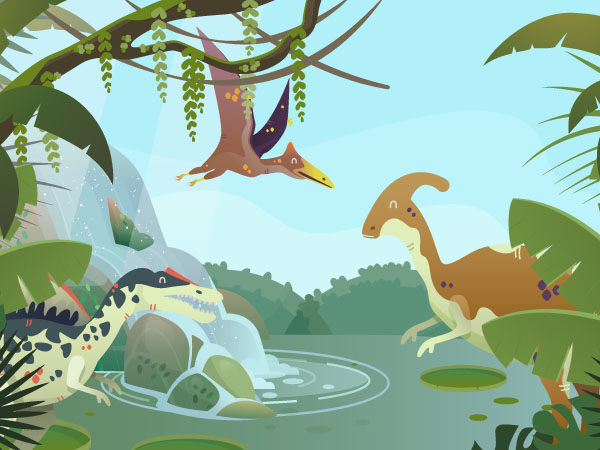
Cartoon dinosaurs near water with trees, one flying overhead in prehistoric scene.
© Elegant Solution/stock.adobe.com

In this lesson mini, students build vocabulary and investigate different dinosaur species, classify dinosaurs based on physical features, and compare and contrast different types of dinosaurs. Through guided and partner readings, students identify key ideas and use evidence to explain how dinosaurs lived based on their features and behaviors. Students engage in collaborative tasks to showcase their understanding, communication, and reasoning skills.

Ideas for Implementation
Science
Literacy
Library media
Learning centers
Intervention or enrichment
Key Vocabulary & Definitions
camouflage (noun): a characteristic that helps animals blend in with their surroundings
Cerapoda (noun): plant-eating dinosaurs that were duck-billed, great horned, or dome-headed; part of the Ornithischia group
extinction (noun): when an entire species, or type, of animal disappears or dies out
fossils (noun): the remains or traces of plants and animals that lived long ago and that give scientists clues about the past
insulation (noun): a body structure and adaptation that keeps an animal warm, such as feathers or fur
Mesozoic era (noun): known as the Age of Reptiles, the geologic time period when dinosaurs inhabited Earth
Ornithischia (noun): a major dinosaur group characterized by bird-hipped dinosaurs
reptile (noun): a cold-blooded animal that breathes air and has scales
Saurischia (noun): a major dinosaur group characterized by lizard-hipped dinosaurs
Sauropoda (noun): plant-eating eating dinosaurs that walked on four legs and had long necks; part of the Saurischia group
Theropoda (noun): meat-eating dinosaurs that walked mostly on their two back legs; part of the Saurischia group
Thyreophora (noun): plated or armored dinosaurs; part of the Ornithischia group
Authentic Learning Extensions
Authentic learning opportunities for studying dinosaurs involve real-world experiences and practical applications that help students understand the importance of exploring and classifying types of dinosaurs in a meaningful way. Here are some examples:
Compare and Contrast: Offer students different figurines or dinosaur cards that represent the dinosaur species studied in this unit. Challenge students to use a 2-Circle or 3-Circle Venn Diagram to compare and contrast key features and then write a brief response using linking words (e.g., similarly, both, however, but) to explain their ideas.
Dinosaur Art Project: Invite students to make 3-D representations of different types of dinosaurs using recycled materials, cardboard, or modeling clay. Invite students to paint and decorate their dinosaurs. As an extension, have them write a card with important information about their dinosaur, similar to museum display labels that explain an animal’s features and habitat and when they lived.
Dinosaur Movement Games: Challenge students to create games that reflect key learning and integrate movement. Facilitate a class brainstorm to set expectations. One example is a Dinosaur Simon Says game that uses movements like walking, running, or flying. Have students explain how the game represents their learning.

Choose Activity

3
Dinosaur Exploration and Classification

Activity

1 :

Dinosaur Vocabulary Learning Lab

By the end of the activity, students will be able to identify and define key vocabulary and main ideas about dinosaurs to understand how they behaved and lived millions of years ago.

>40

Minutes

Materials

Coloring supplies (one set per student)
Mystery bag (for teacher use)
Whiteboard and display
Writing utensils

Resources

Prepare for the Activity: To prepare for the dinosaur vocabulary drawing game in step 9, print and cut out the Dinosaur Vocabulary Words and place the slips of paper inside a mystery bag.
1
Tell students that during today’s activity they will learn about how dinosaurs lived millions of years ago.
2
Begin by asking students what they know about dinosaurs. As students share, record their ideas on the board.
3
Display and preview the Dinosaur article, sharing that it covers when and where dinosaurs lived, how they behaved, what they looked like, their life cycle, and why they became extinct. Then give each student a copy of the article along with a Mini Glossary graphic organizer.
4
Invite students to work with a partner to skim the article, highlight five vocabulary words, and complete the graphic organizer. Model an example with the word extinct.
Vocabulary Word: extinct
Definition: when an entire species, or type, of animal disappears or dies out
Word Associations: disappear, dinosaurs, fossils, erase
Sentence: Dinosaurs became extinct millions of years ago.
Drawing: ❎🦕
5
Allot time for students to complete the organizer. After students finish, bring the class back together and ask for student pairs to share the vocabulary words they chose. Record words on the board.
6
Instruct students to read the Dinosaur article with a partner and highlight the main ideas. Model an example by displaying the “Introduction” section of the article and identifying a main idea together as a class. For example, “Scientists have learned about how dinosaurs are related to today’s animals by studying dinosaur fossils.”
7
Give a Sketch and Share handout to each student, and have them work independently to illustrate what they learned about dinosaurs in the “My Sketch” box.
8
After 5 minutes, invite students to share their sketch with a new partner and explain what their sketch is about. After the partner discussion, instruct students to answer the reflection question at the bottom of the handout.
9
Reassemble the class and play a vocabulary drawing game with dinosaur-themed words to review the key vocabulary from the article. Explain that students will work in teams to guess drawings related to dinosaurs.
a)
Divide the class into six teams, and have members of each team sit together.
b)
Tell each team to pick a group representative to draw a picture related to a mystery dinosaur word on the board. The whole class will then try to guess the word. Model an example with the word egg, and draw a dinosaur egg (🥚). Have students raise their hands for a chance to guess the word.
c)
Draw a score chart on the board with the names of the teams. Consider simply numbering the teams or having students pick dinosaur-related names like “T. Rexes” or “Amazing Dinosaurs.”
d)
Call on one of the groups, and have the group representative come up to the front and randomly choose a word from the mystery bag with the Dinosaur Vocabulary Words. Then set a 1-minute timer, and tell the student to begin to draw.
e)
During the game, the whole class tries to guess, and the first student to raise their hand and guess correctly wins a point for their team.
10
After students finish the game, tally up the score, praise the winning team, and congratulate all students for their efforts.
11
Reassemble the class, and facilitate a whole-group discussion for students to reflect on their learning about dinosaur words. Consider allowing them to use the Dinosaur article for reference. Ask:
What are the three geologic periods when dinosaurs lived? (Draw and label a timeline on the board.)
What are some special features dinosaurs used to hunt and survive?
How did feathers or horns help the dinosaurs that had them?
What did you learn about the life cycle of dinosaurs?
What are some new words you learned about dinosaurs?
Language Support: Offer students the option of reading the Dinosaur article both in English and in their home languages. Pre-teach key vocabulary from the English version of the article, and provide students with a Picture Glossary graphic organizer instead of the Mini Glossary graphic organizer.
Vocabulary Words: Offer students a list of vocabulary words from the Dinosaur article to choose from after skimming the article. This ensures that students identify key vocabulary to record on the Mini Glossary graphic organizer and enhances overall understanding of the text presented.
Dinosaur Facts: Have students write a summary of dinosaur facts using the key vocabulary words from the Dinosaur article. This approach helps students synthesize new learning and gives them practice using new vocabulary in context.
Vocabulary Game Variations: Instead of playing a vocabulary drawing game, have students design their own vocabulary game to practice the new words from the article. This approach develops students’ creative and collaborative skills.
Parallel Teaching: For collaborative teaching and learning environments, this learning activity is well suited to a Parallel Teaching strategy. In this model, the class is divided into two groups, and each teacher delivers the same activity simultaneously to their group. This reduces the student-teacher ratio, allowing for more interaction and individualized attention. With smaller groups, students are more likely to participate actively and receive immediate feedback, which fosters a deeper understanding of the content and promotes a more engaging learning experience. Evidence suggests that small-group instruction leads to increased student engagement and improved academic outcomes.
Dinosaur Exploration and Classification

Activity

2:

Dinosaur Survival Research Lab

By the end of the activity, students will be able to explain how different dinosaur species survived using specific features and traits.

>40

Minutes

Prepare for the Activity: To prepare for the research activity in step 5, print and cut out the Dinosaur Names and place the slips inside the mystery bag.
1
Tell students that during today’s activity they will research different types of dinosaurs to find out how their features and behaviors helped them survive millions of years ago.
2
Begin the lesson by displaying the Archaeopteryx video. To set a purpose for viewing, ask students to watch the video and reflect on how scientists learn about dinosaurs. After the video, call on volunteers to share what they learned. Guide student responses by clarifying ideas using factual information when needed.
3
Display the “Physical Features and Behavior” section of the Dinosaur article. Give each student a copy of the full article or just the “Physical Features and Behavior” section. Allot a few minutes for students to read the section independently, and then facilitate a class discussion about which features and behaviors different dinosaurs used for survival. Encourage evidence-based answers using the text. Ask:
How large were dinosaurs?
What colors were dinosaurs, and how did these colors help them survive?
How do scientists believe that dinosaurs used their feathers?
Why did ornithischians have flat teeth and horn-shaped beaks?
Which dinosaurs were built to hunt, and why?
How did sauropods move? How did they use their legs and tail?
4
Display and give each student a T-Chart graphic organizer. Guide students to label the columns “Features” (physical traits) and “Behaviors” (actions). Model the types of information to record in each column by offering the following examples:
Feature: “Some dinosaurs had coloring that may have helped them blend into their surroundings.”
Behavior: “Some dinosaurs used their teeth to catch food.”
Have students work with a partner to complete the graphic organizer using information from the article. Circulate to support student understanding. After a set time, bring the class back together and review students’ ideas.
5
Tell students that they will work in groups of two or three to research the features and behaviors of a randomly assigned dinosaur. Share that students will research their assigned dinosaur’s physical traits and behaviors using a digital device and a district-approved search engine.
a)
Divide the class into groups of two or three students.
b)
Walk around the room with the mystery bag, and have each group pull a slip of paper from the bag to find out which dinosaur they will research.
c)
Give each group a Dinosaur Traits and Behaviors Research Guide, and review with the class the questions on the guide.
d)
Give each student a digital device, and have them use a district-approved search engine to conduct their research and answer the handout questions.
e)
Model a few keywords, phrases, and questions that students can use for effective search results (e.g., “Physical and behavioral traits of a T. rex” or “What did the T. rex eat?”).
f)
As groups work, circulate the room and offer support as needed.
6
If possible, instruct student groups to identify and print and cut out a few images of their assigned dinosaur and glue those images onto the back of the Dinosaur Traits and Behavior Research Guide. If printing is not available, encourage students to draw their dinosaur instead.
7
Assign a group exchange for students to share their dinosaur knowledge. Write the following questions on the board, and guide students to refer to them in their group discussions:
Which dinosaur did you research?
What did your dinosaur look like, and how did it behave?
What is the most interesting fact you learned?
8
Wrap up the activity by bringing the class back together and calling on volunteers to share something they learned about their assigned dinosaurs. As students share, record the name of the dinosaur and what students learned on the board.
9
Close the activity by writing the word dinosaurs in the middle of the board and having student volunteers share one word or phrase to describe them. Write students’ ideas in the space surrounding the word dinosaurs (e.g., extinct, plant eaters, lizard-like).
Language Support: For students who benefit from additional language support, pre-teach key vocabulary from the Dinosaur article, and use visual aids to enhance understanding. Provide a translated version of the Archaeopteryx video and Dinosaur article along with the English versions to enhance understanding of main ideas. Pair multilingual students with supportive peers who speak their home languages to complete the group research project.
Adapted Research Project: Provide an adapted version of the research project, and offer students selected printed resources to research information about dinosaurs. This keeps the activity focused on teacher-vetted resources and keeps students focused on finding key ideas to complete their guide.
Digital Presentation: Challenge students to build on their research and prepare a slideshow using a district-approved digital design tool to present their work. This approach supports students in synthesizing main ideas and developing oral skills.
Dinosaur Article: Instead of having students conduct a research task, divide the class into groups and assign each group a section of the Dinosaur article on which to prepare a presentation. This approach supports students in internalizing new information and teaching it to their peers.
Team Teaching: For collaborative teaching and learning environments, this learning activity is well suited to a Team Teaching strategy. In this model, sometimes referred to as “tag team teaching,” both teachers deliver instruction together, often alternating or integrating their teaching styles seamlessly. This collaborative approach provides students with multiple perspectives and teaching styles, enriching their learning experience. By modeling effective teamwork and communication, this approach demonstrates how different viewpoints can enhance understanding and create a dynamic and interactive classroom environment. Evidence indicates that team teaching can enhance student engagement and provide a richer, more diverse educational experience.
Activity Introduction: Teacher A introduces students to the concept of features and behaviors that aided in survival of dinosaurs. Teacher B displays the Archaeopteryx video and guides a discussion of how scientists learn about dinosaurs.
Section Reading and Discussion: Teacher A displays and gives a copy of the “Physical Features and Behavior” section of the Dinosaur article to each student, and leads a discussion about which features and behaviors different dinosaurs used for survival. Teacher B circulates to enrich student engagement.
T-Chart: Teacher A displays a T-Chart graphic organizer and writes “Features” (physical dinosaur traits) and “Behaviors” (actions) as the column headings. Teacher B gives each student a copy of the organizer while Teacher A models an example of each. Teacher B instructs students to complete the T-Chart with a nearby peer, and both teachers circulate the room as pairs complete the task.
Group Research Project: Teacher A tells students that they will work in groups to research the features and behaviors of an assigned dinosaur. Teacher B has students randomly draw a dinosaur name from the mystery bag while Teacher A distributes digital devices. Both teachers circulate to offer support as needed.
Activity Wrap-Up: Teacher A wraps up the activity by calling on volunteers to share something they learned about their assigned dinosaurs. Teacher B closes by writing the word dinosaurs on the board and having students share one word or phrase to describe them.
Dinosaur Exploration and Classification

Activity

3:

Compare and Classify Dinosaurs

By the end of the activity, students will be able to classify, compare, and contrast different types of dinosaurs.

>40

Minutes

Prepare for the Activity: To prepare for the sorting activity in step 4, print and cut out enough Dinosaur Types Cards so that each group has a set.
1
Tell students that during today’s activity they will classify, compare, and contrast different types of dinosaurs.
2
Begin the lesson by displaying the Velociraptor image and the Triceratops image, and asking students to describe the different traits they observe. Acknowledge all responses, and guide students toward accurate, evidence-based observations.
3
Display and give each student a copy of the Dinosaurs at a Glance article. Read aloud the “Introduction” and “Dinosaurs by Type” sections of the article, encouraging students to follow along on their copies. Highlight that dinosaurs are classified into different groups and subgroups, such as the following:
Saurischia group (lizard-hipped dinosaurs)
Sauropoda (sauropods): ate plants, walked on four legs, had long neck
Theropoda (theropods): ate meat, most walked on their back two legs
Ornithischia group (bird-hipped dinosaurs)
Cerapoda (cerapods): include duck-billed, great horned, and dome-headed dinosaurs
Thyreophora: mostly made up of plated dinosaurs
Pause to check for understanding and clarify vocabulary as needed.
4
Divide the class into groups of three students, and distribute the Dinosaur Types Cards and Dinosaur Types Sorting Mat so that students can classify the dinosaur cards into Sauropoda, Theropoda, Cerapoda, and Thyreophora subgroups. Once students have classified the dinosaurs, have them glue the cards onto the sorting mat. After students finish, bring the class back together and review the answers:
Sauropoda: Brachiosaurus, Diplodocus, Plateosaurus
Theropoda: Allosaurus, Oviraptor, Velociraptor
Cerapoda: Iguanodon, Maiasaura, Triceratops
Thyreophora: Ankylosaurus, Euoplocephalus, Stegosaurus
5
Display the Venn Diagram graphic organizer, and write “Velociraptor” and “Triceratops” as the circle headings. Give a copy of the graphic organizer to each student, and instruct them to copy the headings.
6
Distribute a digital device to each student so that they can follow along as you display and read aloud the Velociraptor article and then the Triceratops article. As you read each article aloud, pause to ask comprehension questions and invite students to take notes in the larger, nonoverlapping parts of their Venn diagrams.
7
Invite students to evaluate the class notes and then write in the central, shared section of their diagrams anything that Velociraptor and Triceratops have in common. Afterward, call on volunteers to share their Venn diagrams.
8
Divide the class into pairs, and explain that now they will choose two dinosaurs mentioned in the Dinosaurs at a Glance article to compare and contrast.
a)
Distribute another Venn Diagram graphic organizer to each student.
b)
Guide each pair to choose two dinosaurs hyperlinked in the “Dinosaurs by Type” section of the article to compare and contrast (that is, other than Velociraptor and Triceratops).
c)
Instruct students to read the two articles with their partner using their digital devices.
d)
Guide students to identify key dinosaur traits and behaviors and record similarities and differences in their Venn diagrams. Remind students to use information from the text and to record ideas in their own words.
9
After students finish, have students walk around the room and exchange their work with another pair. Then bring the class back together, and call on volunteers to share their findings.
10
Wrap up the activity by asking volunteers, “How were dinosaur types similar and different?” Encourage students to reference their diagrams and use academic vocabulary in their responses.
Language Support: For students who benefit from additional language support, pre-teach key vocabulary from the Dinosaurs at a Glance article, and use visual aids to enhance understanding. Pair multilingual students with supportive peers who speak their home languages to complete the partner reading and comparison task. Offer students the option of completing their Venn diagrams in their home languages.
Adapted Venn Diagram: Provide an adapted version of the Venn Diagram graphic organizer with guiding questions and sentence starters to support students in identifying the similarities and differences among types of dinosaurs. Offer a word bank with linking words to support students in comparing and contrasting (e.g., similarly, both, also; but, however, on the other hand).
Written Reflection: Challenge students to use their Venn Diagram graphic organizers to write a brief reflection comparing and contrasting their chosen dinosaurs. This approach helps students use Venn diagrams as a launchpad for practicing comparative analysis.
Dinosaurs by Time Periods: Instead of having students focus on classifying, comparing, and contrasting dinosaurs by their types, have them focus on organizing dinosaurs by the geologic time periods (Triassic, Jurassic, and Cretaceous) in which they lived. Have students build timelines to expand their chronological thinking skills.
One Teaching, One Assisting: For collaborative teaching and learning environments, this learning activity is well suited to a One Teaching, One Assisting strategy. In this model, one teacher leads the activity while the other circulates, assisting individual students as needed. This ensures that when students encounter difficulties, they receive immediate help in the form of personalized support and answers to their questions. By addressing students’ unique needs and keeping them on track, this approach enhances individual learning experiences and fosters a supportive classroom environment. Studies indicate that immediate feedback and individualized attention can significantly enhance student understanding and retention of material.
Activity Introduction: The lead teacher tells students that during today’s activity they will classify, compare, and contrast different types of dinosaurs. The assisting teacher displays images of a Velociraptor and a Triceratops and asks students to describe the different dinosaur traits they notice.
Classify by Dinosaur Types: The lead teacher reads aloud the “Introduction” and “Dinosaurs by Type” sections of the Dinosaurs at a Glance article, highlighting that dinosaurs are classified into two large groups, Saurischia (lizard-hipped) and Ornithischia (bird-hipped), and four subgroups, Sauropoda, Theropoda, Cerapoda, and Thyreophora. The assisting teacher divides the class into groups of three students and distributes the Dinosaur Types Cards and Dinosaur Types Mat so that students can classify the dinosaur cards into subgroups.
Venn Diagram Guided Practice: The lead teacher guides the whole class to read two articles and complete a Venn diagram to compare and contrast Velociraptor and Triceratops. The assisting teacher gives each student a copy of the Venn Diagram graphic organizer and a digital device.
Venn Diagram Partner Work: The lead teacher divides the class into pairs and asks each pair to choose two dinosaurs to compare and contrast. The assisting teacher distributes another copy of the Venn Diagram graphic organizer and guides each pair to choose two dinosaurs hyperlinked in the “Dinosaurs by Type” section of the Dinosaurs at a Glance article. Once students finish, the lead teacher has students walk around the room and exchange their work with another pair.
Activity Wrap-Up: Both teachers wrap up the activity by leading a class discussion of how types of dinosaurs were similar and different.
Dinosaur Exploration and Classification

Activity

4:

Minutes

Materials

copy text here
copy text here

Resources

Prepare for the Activity:
1
copy text here
2
copy text here
3
copy text here
a)
copy text here
TEXT BLOCK: Lorem ipsum dolor sit amet, consectetur adipiscing elit, sed do eiusmod tempor incididunt ut labore et dolore magna aliqua. Ut enim ad minim veniam,
Lorem ipsum dolor sit amet, consectetur adipiscing elit, sed do eiusmod tempor incididunt ut labore et dolore magna aliqua. Ut enim ad minim veniam, quis nostrud exercitation ullamco laboris nisi ut aliquip ex ea commodo consequat. Duis aute irure dolor in reprehenderit in voluptate velit esse cillum .
copy text here
copy text here
Lorem ipsum dolor sit amet, consectetur adipiscing elit, sed do eiusmod tempor incididunt ut labore et dolore magna aliqua. Ut enim ad minim veniam, quis nostrud exercitation ullamco laboris nisi ut aliquip ex ea commodo consequat. Duis aute irure dolor in reprehenderit in voluptate velit esse cillum .
copy text here
copy text here
copy text here
Dinosaur Exploration and Classification

Activity

5:

Minutes

Materials

copy text here
copy text here

Resources

Prepare for the Activity:
1
copy text here
2
copy text here
3
copy text here
a)
copy text here
TEXT BLOCK: Lorem ipsum dolor sit amet, consectetur adipiscing elit, sed do eiusmod tempor incididunt ut labore et dolore magna aliqua. Ut enim ad minim veniam,
Lorem ipsum dolor sit amet, consectetur adipiscing elit, sed do eiusmod tempor incididunt ut labore et dolore magna aliqua. Ut enim ad minim veniam, quis nostrud exercitation ullamco laboris nisi ut aliquip ex ea commodo consequat. Duis aute irure dolor in reprehenderit in voluptate velit esse cillum .
copy text here
copy text here
Lorem ipsum dolor sit amet, consectetur adipiscing elit, sed do eiusmod tempor incididunt ut labore et dolore magna aliqua. Ut enim ad minim veniam, quis nostrud exercitation ullamco laboris nisi ut aliquip ex ea commodo consequat. Duis aute irure dolor in reprehenderit in voluptate velit esse cillum .
copy text here
copy text here
copy text here
© Encyclopædia Britannica, Inc. All rights reserved.
